MICCAI Educational Challenge 2026 - From Pixels to Patients
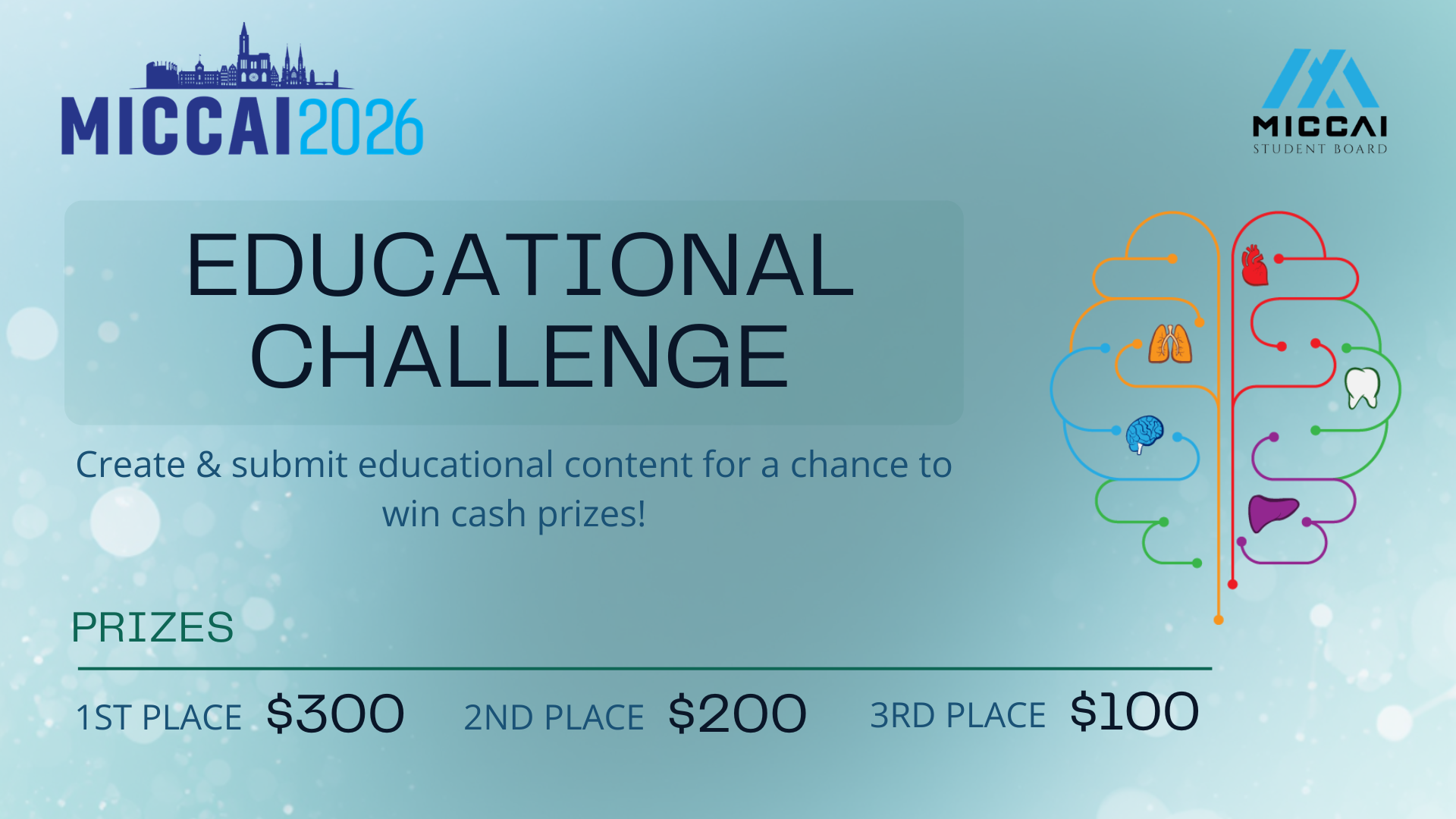
The MICCAI Educational Challenge will be held for the 13th time, leading up to and concluding at MICCAI 2026 in Strasbourg. The goal of the challenge is to encourage members of the MICCAI community to create and share educational materials, covering fundamental concepts in medical image computing and computer-assisted interventions.
The first prize winner of the MICCAI Educational Challenge will receive a prize of $300, sponsored by the MICCAI society. A second and third-place prize of ($200 and $100, respectively) will also be awarded. The winner(s) will be decided by popularity vote and announced at MICCAI 2026. Tutorials may be formatted as videos, papers, presentations, IPython Notebooks, GitHub sources and documentation, or blog posts.
Motivation
There are many fundamental concepts unique to medical image computing and computer-assisted interventions. However, finding good learning resources can be difficult, whether you are a new student or an established researcher exploring a new topic.
With the MICCAI Educational Challenge we are building a library of tutorials relevant to the MICCAI community, created by and for its members. Establishing a comprehensive collection will make the field more accessible and shorten the startup time for new students. The MEC will be repeated at future MICCAI conferences, building a large corpus of educational resources for the community.
Why this challenge looks different in 2026
For most of the MEC's history, the goal was to help newcomers in the field to learn the basics because good explanations were scarce, and a well-written tutorial filled a real need.
That isn't largely true anymore. A student today can ask an AI assistant to explain U-Net or walk through a transformer architecture and get a reasonable answer in seconds. Static introductions and survey-style tutorials, by and large, don't add much that a chatbot can't provide on demand. So we're shifting what we're asking for.
What we want now are tutorials that teach things an AI assistant can't easily reproduce. First-hand experiences from real projects, code that actually runs on medical data, the perspective of a clinician who has actually used these tools, honest accounts of what was hard, what broke, and what took weeks to figure out. We'd like to see more of that surfaced through this challenge.
What we are looking for
Strong submissions will do at least one of the following:
- Share first-hand experience from a real project, deployment, or collaboration
- Reproduce, benchmark, or critically evaluate existing work, including honest accounts of where methods did not transfer or generalize as expected
- Provide verified, runnable code on real medical data with pinned dependencies and a clean environment
- Bring in a clinician, surgeon, or other domain expert as a named contributor whose perspectives shape the material
- Walk through a specific artifact end to end, including a dataset, a deployment, a workflow, and a regulatory package
- Teach a topic where good learning resources are genuinely scarce (niche modalities, emerging methods that have not yet hit the mainstream, or areas where the existing material is outdated, paywalled, or scattered)
Suggested Topics for Submission
Anything within medical image computing or computer-assisted interventions is welcome. To give a sense of the kinds of tutorials we hope to see:
- Deploying an imaging model into a real clinical environment, and what that actually involves.
- Reproducing a method as a learning exercise. Walking through the implementation, the choices that had to be made, and the parts of the original paper that required interpretation.
- Working with foundation models or vision-language models on medical data, including fine-tuning, prompting, evaluation, and where the standard recipes break.
- Annotation workflows that pair AI tools with clinicians, including inter-rater agreement and failure modes.
- Federated learning across sites, with a focus on the data harmonization work that papers usually omit.
- Calibration, uncertainty, and bias for modern models in clinical settings.
- Regulatory pathways for imaging AI: FDA submissions, EU AI Act high-risk requirements, and predetermined change control plans.
- Reproducibility infrastructure: environments, data versioning, seeds, and the unglamorous work that makes a result hold up.
- Using AI assistants well as a researcher. For example, a guided workflow for reading and understanding a MICCAI paper as a new student.
- AI in the operating room, including surgical videos, intraoperative guidance, or autonomous systems.
Guidelines on AI assistance
You may use AI tools to help draft, edit, or generate parts of your tutorial. We do ask you to disclose the tools you used and how you used them. Also, please make sure the substantive value of the tutorial (including the experience, the code that runs, the judgment calls, the clinical perspectives, the personal reflections) originates from you. Submissions that are essentially LLM output presented as a tutorial will not be competitive, because they offer learners nothing they could not get on their own.
Frequently Asked Questions (FAQ)
- What is the deadline? July 31, 2026 Anywhere on Earth
- What formats are acceptable? You can submit text or video tutorials in any easily accessible format (i.e. jupyter notebook, website, docx/pptx, pdf, mp4, blog, etc...).
- Do I have to have a paper submitted to MICCAI to submit to the MICCAI Educational Challenge? No, everyone is welcome and encouraged to submit to the MEC.
- Does the submission have to be anonymized? This is optional and helpful to the organizers, but not required.
- Do I have to be a student to submit? No, submissions are welcome from all, regardless of experience level. We only suggest that you write your submissions at a level that could be understood by a grad student trying to learn more about your topic.
How to participate
You have complete flexibility in choosing the format of your tutorial. We are accepting:- Video
- Blog Post
- Scientific Paper
- IPython Notebook
- Powerpoint
- GitHub Source Code and Documentation
- Interactive Demos and Websites Interactive Demos and Websites
Participants are encouraged to consider preparing any blog-style submissions as a post through Medium, which will be published directly through the newly created MICCAI Educational Initiative publication on Medium. We've published a getting started article on the Medium channel to help you begin.
Submitted tutorials do not have to be especially long (even a few well thought out slides / pages can be incredibly helpful to beginners). Perhaps you have made something for a lab meeting or blog that would be interesting for the entire community?
Your submission can focus on any fundamental concept or technique related to MICCAI, including but not limited to registration, segmentation, atlases, computational anatomy, machine learning, deep learning, inference, computerized diagnosis, surgical navigation, surgical planning, medical simulation, medical robotics, visualization or software. In particular, the following topics were identified as subjects of interest in a recent Facebook poll: (in order of most to least popular) segmentation, statistical analysis of medical images, computer-assisted intervention, and optical/histology applications.
In previous polls by the MICCAI Student Board, students have additionally indicated that they are especially interested in “How to make it work”, tutorials focused on implementation details not usually discussed in papers. Students also expressed a preference for submissions in the form of blogs and python notebooks. These materials are especially welcomed by the MEC. Tutorials should be comprehensible by Masters and PhD students entering the MICCAI field, to understand basic concepts and commonly used techniques. Tutorials featuring examples using open-source software are also encouraged.
Submission requirements
- The MICCAI Educational Challenge is open to students and academics only.
- All submissions must be in English. This applies to both text and video submissions.
- Word count limit: 4000 words, excluding references. Slide presentations are limited to 40 slides. Note that these are upper limits, and submissions are not required to be nearly this long!
- Videos should be no longer than 20 minutes
- Previously published tutorial papers from past MICCAI's are not eligible.
- Submissions prepared with the help of AI language models, such as ChatGPT, are allowed. However, the use of such a model must be clearly stated in the submission. Submissions without help of AI editing tools are highly encouraged.
You can also look at examples of previous MEC submissions.
Finalists Rule:
- One-Minute Summary Video: Finalists will be required to submit a one-minute video providing a short summary of their submission. This video will be used for promotional purposes and will be made publicly available.
Prize
First prize is $300, sponsored by the MICCAI society, and an interview with a well-known professor published on YouTube to promote their research. The winner will be decided through expert panel judging followed by a popular vote.
All submissions will first be judged by a panel of experts, using an objective evaluation of the achievement of the tutorial goal. Tutorials will be scored based on:- Accuracy of content
- Comprehensiveness of content
- Appropriate level (accessible to new Masters and PhD students)
- Relevance to the MICCAI community
- Clarity
The top 30% of submissions will then proceed to a popular vote held at MICCAI 2026, to decide the winner.
Distribution of a prize is contingent on the MEC receiving at least three submissions, to ensure a level of competition. The first prize winner will receive a prize of $300 and a (upon agreement) possible interview with a renowned professor published on YouTube.
By submitting to the MEC, you (and your co-authors) agree that your submission will be made publicly and freely available on the MEC educational challenge materials website by the MICCAI Student Board.
Submission
Please submit your material through the OpenReview submission portal. Please follow the instructions and fill your submission(s) title, the author(s) name(s), affiliation(s) and relevant information. By submitting to the MEC, you (and your co-authors) agree that your submission will be made publicly and freely available on the MEC educational challenge materials website by the MICCAI Student Board.
Important dates
- Submission deadline: July 31, 2026 Anywhere on Earth
- Announcement of the winner: MICCAI awards ceremony.
All submissions will be made publicly available shortly following MICCAI 2026.
Questions?
Please direct any questions to miccai-student-board@csail.mit.edu.